My name is Charlotte, sometimes known as Ms Lottie, occasionally as The Slightly Mad Quilt Lady. This is my blog, where you'll find me writing a lot about my quilting and textile arts and a little about my family's life in a small seaside town in New Zealand. Haere mai!
Showing posts with label art quilt. Show all posts

Monday, June 29, 2020

Merit Award in the Aotearoa Quilters Aqua Challenge

Aotearoa Quilters runs a colour challenge every year or so, and this time around the theme colour was aqua. They also changed up the size (usually a 12" x 12" square) this time they chose a 12" x 16" rectangle in a portrait orientation. I confess to enjoying the rectangular shape more than the square, it's easier to work with design-wise. But I know squares fit together beautifully on an exhibition wall, so it's swings and roundabouts.

And I was delighted to win a merit prize! Those are the good emails to open. The unexpected ones that tell you you've won something (and not $7.3 billion from a nice man in Nigeria!)

All the entered quilts will be on show at the Taupo Quiltmakers exhibition called Pearls and Water. This is on at the Great Lake Centre, Taupo, October 2nd till October 4th and would be well worth a visit. 

When you think of aqua, what colour do you think of? Greeny-blue? Bluey-green? Teal? Kingfisher? Here's a screenshot of when I search for images of aqua colour - what a variation! 


So I did a colour pull of all my 'aqua-ish' fabrics to get more of an idea of what I had, and to see if anything sparked my ideas button.


As you may know if you've been reading my blog for any length of time, birds feature heavily in my quilts. I have been working with birds in flight recently so I decided to downsize the shapes I'd been working with and play with them on the surface of a piece of aqua hand-dyed fabric I found.


They fell into place so nicely, with such a great sense of movement, that the design didn't take long to finalise at all. The colours of each bird travels from dark teal to lightest sea foam, with a dark purple for some visual interest.


I know this is an absolutely terrible photo, but it gives you an idea of how I sometimes plan quilting lines. This is a photo of the quilt top, placed in a page protector and then drawn on with a dry erase marker.


I finished the quilt with a facing as I felt a binding would constrain the birds and you would lose the sense of them flying off into the distance. I named the quilt "Let Your Spirit Fly Free" in dedication to the first Covid-19 victim in New Zealand, who passed away around the time I was making the quilt.


I quilted it using my trusty domestic BERNINA Aurora 440 as the quilt was nice and small and this machine gives me great control over my free motion quilting. The threads are tied and buried. 

All the quilts will be for sale for $150, and I'd be pleased if it went to a new home. But I'd also be secretly pleased if it came back home after touring New Zealand, as it's one I'm really pleased with and it reminds me of the strange and difficult, but weirdly beautiful time that NZ's Covid-19 lockdown was for me.

The winning quilt and the other merit prizes can be seen on the Aotearoa Quilters Facebook page. I'd like to thank the sponsors who make the prizes possible, especially Quiltique who sponsored my prize. 

Monday, October 14, 2019

Learning to talk about your work

I believe that learning to talk engagingly and intelligently about your work is one of the most important skills an artist can develop.

How many times have you listened to someone talk about their piece and gained a whole new appreciation for it? And how many times have you heard people point out flaws, put themselves down, or say a variation of, “I just liked those fabrics so I made it.” Hmmm. 

And it’s FINE if you DID just 'like' the fabrics! But perhaps you could say, “I liked the way these fabrics worked together and I wanted to play with the proportions and see how it altered the conversation between them.” Same thing really, but just said with a little more agility.


I'm making this blue quilt at the moment because I liked the indigo-dyed napkin that I printed with fern fronds, and I found some other blue leftovers. But instead of saying that, how about, "I wanted to see if I could compose a successful composition using a limited palette."

I do not claim to be that great at speaking about my work, but it’s something I’m aware of and I’m striving to get better at. 

I’ve recently been watching the videos of the Quilt National ‘19 exhibitors. These are short videos of makers talking about their quilts. And it’s been a great learning experience (besides also being able to enjoy the beautiful works.) I try and think when I’m listening:

Are they making sense?
Are they adding to the story I see visually?
Have I learnt something?

Here’s the link if you want to listen and watch too.

Sunday, September 22, 2019

Dawning

I finished this piece a few days ago. Although I haven't put a hanging sleeve on it yet, so I guess it's not 100% finished. Do you count your finishes from when you've put the last stitch in the binding, or from when they are labelled, sleeved, photographed, documented....etc. etc?


This quilt is 18 1/4 inches by 18 3/4 inches. A very inconvenient size really, but that's just how it ended up.

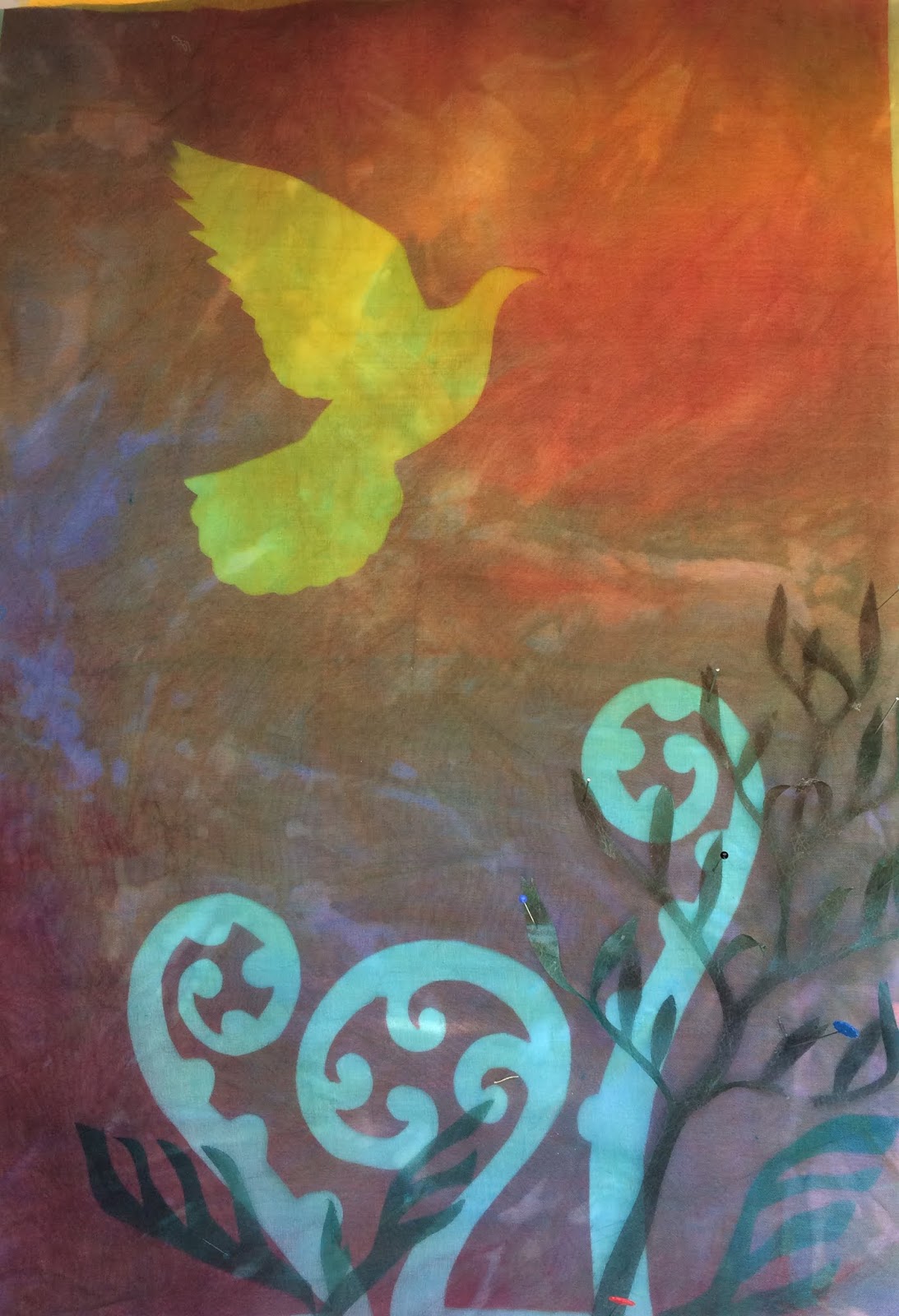
I began this piece because I needed some more organza quilts for a class I was running. At that time my other samples were in the middle of the ocean, being posted back from when I was teaching in Canada (they arrived just the other day). When it started, it looked like this:


It's three layers of fabric. There is a salmon-coloured hand-dye underneath a layer of multicoloured silk organza.  The bird is cut out of the salmon fabric, as are the unfolding fern fronds, and there is a yellow fabric under the bird and white fabric under the fronds. 

The cut out bird ended up on another composition.


But I wasn't happy with the dominance of the bright fern fronds. So I took the yellow fabric away from behind the bird and replaced it with white. Then I replaced the white that was behind the fern fronds with a dark, rich purple (and got rid of the flax stalk).
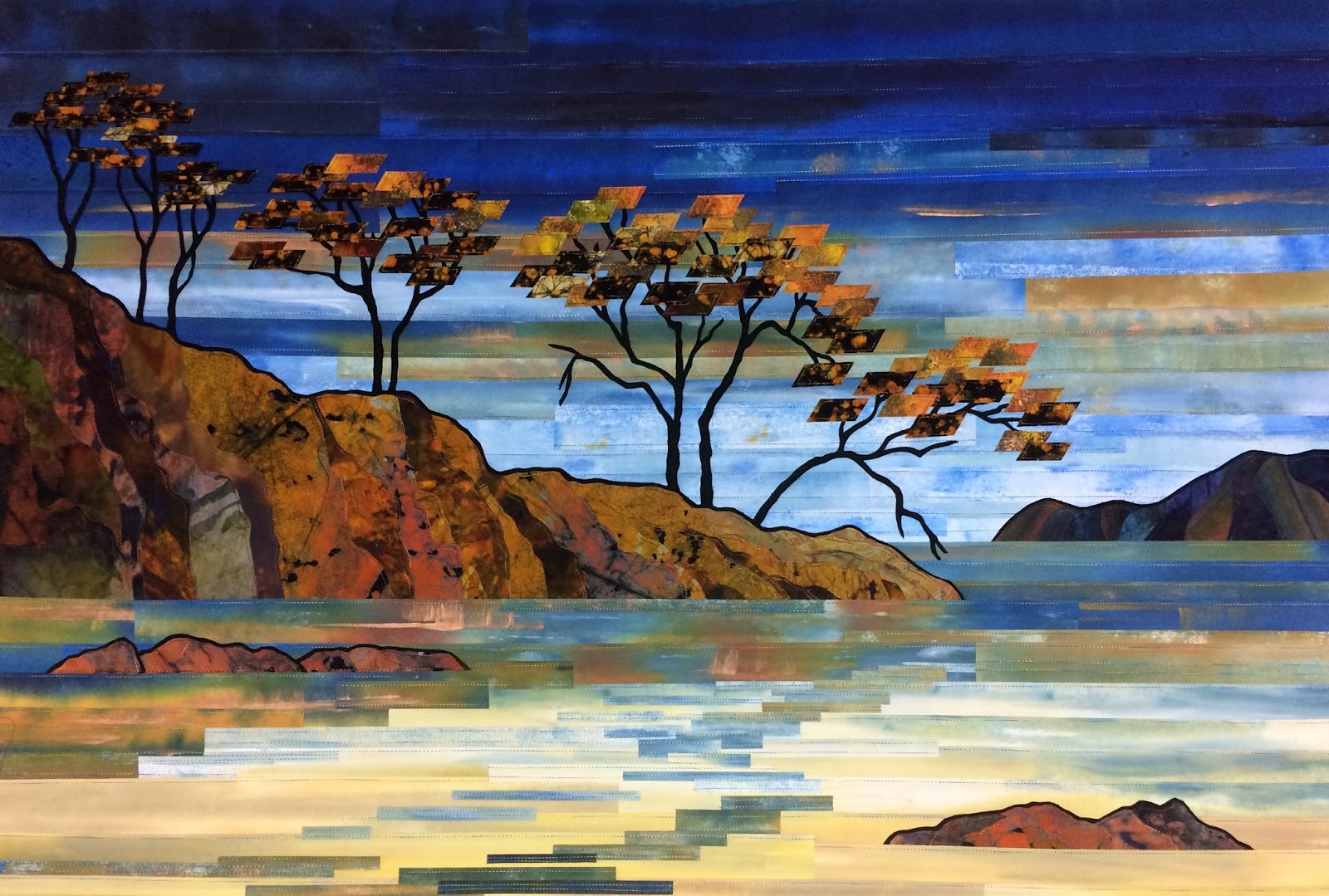

I really liked the way the purple fabric extended the composition beyond the edges of the salmon fabric, so I cut them in a hill shape and included it in the design.


The feathers came last.  And I played around with different layouts to get the feel that I was going for.


For me, this quilt is about the spirituality of dawn, that beautiful, sacred, quiet time. When we can look at the sun rise and be thankful for a new day with all its potential. The feathers are a symbol of what the bird is leaving behind to rise towards and celebrate that new day.


I added a little red hill off to the left for balance, some paint to define the main hill and highlight the bird, and then quilted the whole thing. You may notice the peaked window shape quilted in, which is another nod to the spiritual feel of the quilt.

It's finished with a facing so there are no edges to confine the bird.

Friday, October 26, 2018

The big snip

I didn't show you a photo of the finished 'Dawn Contemplation' quilt.  When you last saw it, I was pushing to get it finished for the KOAST art trail, and it looked like this:


Well, the first day of the trail saw me stitching on the binding, but I managed to finish that and get a sleeve on it and it was on display on the second day.  I added some colour and a bit more stitching to the woman to give her more depth and make her more part of the whole image rather than just 'on top'.  I also added a bit more to the bird above her head.  And it's always amazing how finishes the edges makes it look so much better.

The colour of the binding was a hard choice.  I auditioned many before I went with this tan colour.  It was a serendipitous choice, it just happened to fall next to the quilt when I was looking through my purple and pink hand dyes.  I really liked how it complemented the blues and purples rather than blended with them.  And the dark grey/blacks I'd tried just looked flat, so tan it was.


But, and it's a really big but.

I'm thinking of taking my rotary cutter to it.


I'm not entirely happy with the bird above the woman's head.  It's not quite right.  Then when I was editing my image before uploading it to the blog, I played with a few croppings.  And I think I really like the image above.

The question is, do I like it better than the finished quilt as it is now?

So what do you think?

Chop, or not?

Thursday, October 18, 2018

Pushing hard towards the finish

Tomorrow is KOAST (Kerikeri Open Art Studios Trail) set up.  I'm a guest artist at a shared venue, so instead of opening my studio for visitors, I'm setting up a display and pretend studio in a hall.  Luckily there is a good friend of mine sharing the venue, and some of the residents at the village where we will be are putting on a Devonshire Tea to raise money for Hospice.  So I'll have good company and hopefully great tea!

Tonight is one of my 'Blogtober' nights.  Earlier this month I pledged to blog every second day to help get myself back into the habit.  And it's going great.  I haven't run out of things to blog about, people have been engaged and interested, and I'm enjoying it.

But tonight I'm doing the final push to get another quilt finished to show at KOAST.  So you'll forgive me if this blog post is short and fairly shallow on content.  Here's the quilt I'm trying to finish:


While I've been working on this quilt I've been telling myself a narrative about that contemplative hour around dawn.  Occasionally I'll get up really early (when I don't have to) and manage a cup of tea with no one else around.  The dawn chorus is the soundtrack, I'll write morning pages, and I'll feel extremely contented and full of expectation, like the day is full of promise.

Maybe I've just named this quilt.  Dawn Contemplation.

Come and see me (and hopefully this finished quilt) this weekend at Oakridge, off Cannon Drive, right in the heart of Kerikeri.  There will be two other artisits there, you can buy a Devonshire Tea to support Hospice and you'll be able to buy a trail guide to go and visit other artists too.

Tuesday, October 16, 2018

Why I use silk organza in my art quilts.

Jaye commented on my last post and asked:
Do you have a color preference for silk organza or tulle? Is there a difference in the two fabrics? Do they disappear once quilted or can you see the color of the organza (tulle-we use tulle here, though I suppose people use silk organza. I haven't heard much about silk organza used in the way you are using it) 
I started replying to her and the more I wrote the more I realised that this topic deserved a whole blog post all to itself.

Hand dyed silk organza

So.

Tulle is a synthetic fabric and you can buy it in just about all colours of the rainbow.  It is almost like a fine netting but it is fairly stiff.  If you use it in art quilts as an overlay, it can provide shading or highlights.  I once created a (slightly scary) self-portrait using layers of tulle.

This was done in 2010, it's nice to see my free-motion quilting has come a long way!

But tulle has scratchy edges when it's cut and the holes in it give a texture to the quilt top that I don't really want.  

I took a Susan Carlson class once and she sometimes uses a layer of tulle over her whole quilt to hold all her tiny collage pieces down.  It's a handy technique.  But I find that if I use it as an overlay over my entire quilt, it 'deadens' the look of the quilt a bit as the tulle is all one solid colour, even if you can't really see it except close up.

You can buy white tulle and paint it, but it's not as easy to colour as silk organza.

You can get finer grades of tulle - often known as netting - but while softer and finer, it still has the holey texture to it, and I can't always find it in shops.

Silk organza is finer, it's a natural fibre so easier to colour, and it has a sheer finish to it so I don't get that added texture from the weave.  Because the weave is finer, the appareance of the fabric is 'denser'.  I can use it like a piece of cotton fabric, such as an applique shape, but it still has transparency.

I first came across silk organza when I did a workshop with Jeanette DeNicolis Meyer in 2012.  We painted pieces of silk organza and then worked on abstract compositions layering up the colours.  I fell in love with the luminous qualities and the complexity of colour that you could get from layering them.


Above is one of my pieces in progress from that workshop where you can see the layers of fine colour.


And here's my beautiful friend, Sue, working on her painterly piece.  I adored how she had a piece with multiple colours, I hadn't thought to try that.

I also came across a book by Melanie Testa, titled, "Inspired to Quilt."


Melanie also used silk organza in her quilts, often as whole overlays, and she would paint it or use thickened dyes to colour it.  Her quilts are glorious, with lovely colour and transparency.

So these strands sort of all came together over the years to lead me down the silk organza path. One of my first quilts where I used it was 'Sunset Tui'.  I was using leftovers from Jeanette's class cut into curving shapes to create the background.  I attempted to free-motion quilt those pieces down but got frustrated by all the edges constantly lifting up as I would run my darning foot over them.  I put the quilt away for a while in frustration.


Then eventually I used information from Melanie's book to make a whole silk organza overlay for the whole quilt.  I used stencils to print a bird and flax frond on it and painted the rest.  The dreamy colour it made and the ease of using it to hold all the fiddly bits down had me hooked.


So now I buy silk organza wholesale and dye it myself.  I love the colours and I love to have more than one colour in a piece so I can get that range of colour onto my quilt top.  I also love that I can stencil an image onto it, which you cannot with tulle because of the open holey weave.

The other thing I can do with organza that I can't do with tulle is use a fusible web with it.  I prefer Mistyfuse because it is so fine that it doesn't come through the sheerness of the organza, but I have also used Vlisofix with some success.  However, a fusible with defined texture to it like Steam-a-seam shows very clearly through the organza and I won't use it.


Above is a picture of some of my hand-dyed silk organzas ready to use in quilts.

I found a great blog post over at Droplet Weddings, with good images, on the differences between several types of sheer fabrics.  So if you need clarification of what the different sheer fabrics look and drape like, head over there.  She say that silk organza has a lot of body to it and she finds it quite stiff.  I will add that once it is dyed and washed it softens up, but having a bit of body is not a bad thing with sheer fabrics when you are using them in art quilts!

I hope that answers your questions, Jaye.  I don't know many other people who use silk organza in the way I do, but I love it and the effects it can give.

Monday, October 15, 2018

Piwakawaka in Dappled Light

I remember spending a lot of time in the bush as a kid.  We lived on a 15 acre block that had lots of regenerating native bush and some huge old macrocarpa trees and we would run around and climb trees and play games and explore.

There's a special kind of light that hits the forest floor through the undergrowth.  It's green and bright and dark and soft all at the same time.  And that's often where you'd find the fantails, or piwakawaka, hanging out.  They are bug eaters and I guess they can see the bugs better in the shafts of sunlight.  They used to follow us, eating the bugs that we would stir up with our passage through the branches.


I started this quilt with a reverse applique.  The positive cut out of the dark grey leaves got used for another quilt, but I had cut them out of a big piece of fabric so I could use the negative shape too.  I placed some bright green hand-dyed fabric behind the grey fabric and fused it place.


Next came an overlay of silk organza to tone it down a bit and tie it together.  I stencilled a few fern fronds (the burgandy and the white one) onto the silk overlay to go with the light green fronds that are underneath.


The fantail shapes are a pinky fabric underneath the overlay.  The overlay is mostly green but had some blue in that upper region and I wanted to pick that up and get some warmth into that top corner so pink birds plus blue overlay equals a little bit purple.

I added some coloured pencil detail to the birds before I sandwiched everything together and began quilting it.  I began with the shapes that would create a foundation - a circle (marked with a mixing bowl) and the outlines of the leaves, fronds and birds.


I even recorded a little video of some of the free-motion quilting I did on one of the fern fronds.  I mistakenly call it a nikau frond in the video - who knows why!


If you follow me on Instagram (find me here), you will have seen the bottom photo of the fantail quilting in progress.  I wanted to convey the funny way the birds dart and flit and circle and almost seem to play, but are actually hunting and feeding.  


And here they are finished.  I had a lot of fun doing the 'graffiti' quilting.  Free-form flowy shapes, a few pebbles and paislies thrown in to fill up the corners.


I used an organic straight line background texture for the rest of the quilt.  It pushes the background back nicely and provides a good contrast in texture to the quilting inside the circle.  I varied the colour of the thread to help convey the dappled light feeling.  The photo above is taken in very strong side sunlight to show you the texture.


I'm not entirely sure of the quilt's name yet.  But I had better decide quickly as it will be on display and for sale at KOAST this coming weekend!

Saturday, April 14, 2018

Name That Quilt!

Every step in making a quilt is a little step closer to a finish.  But there is 'finished' and then there is 'finished, finished'.  Too often in the past I'd breath a satisfied sigh when I'd taken the last stitch in the binding, then I'd put the quilt down and never get the other little finishing tasks done.   I now consider a quilt to be finished when it is named, labelled, has a hanging mechanism, and is documented and photographed.


When I talk to other quilters and artists, each has a least favourite part of the process of making their work.  For some it's the cutting out, others hate binding.  Some claim they don't dislike ANY part - but I'm sure they're telling fibs!  I bet there is one thing they they always put off, even if just for five minutes...


My least favourite bit varies.  Quite often it's the photography.  I'm getting better at it, and I've got lights now, which make the whole process easier.  But it's just so much faffing around!  I'd much rather sew, or dye, or audition fabrics, or anything else really.  I can't say that sewing labels or hanging sleeves has ever made my heart sing, but I actually quite enjoy hand stitching binding on, when I know it makes many people groan!

Anyway, this last week, my least favourite bit has been the naming of quilts.  I'm trying to come up with a name for my lastest finish.

Untitled as yet by Charlotte Scott 36cm x 55cm
This quilt is relatively small and was started with offcuts from the larger quilt that I'm working on.  

(In case you were wondering about my 'restart my making mojo' process that I was going through - well, it was a success!  I've been working away steadily, and now it's just the usual challenges, like time managment etc)

Here's the larger quilt still in progress:


This one will need a name at some point too, but at present its working name is The Heron Maiden quilt (the HM quilt).  Have you ever read any of the classic Japanese folk stories about cranes turning into women to return the favour of being rescued from a trap?   I've been telling myself those stories as I've been making the quilt, but twisting them into tales about a New Zealand white-faced heron turning into a maiden, then turning back into a heron after she loses her love, or perhaps after she tires of him, depending on how I feel on the day.


Can you see how the nameless quilt has connections to the HM quilt?  The branch in the nameless quilt is the cut-away background of the branch in the bottom right of the HM quilt, and the heron is a third, brighter, version of the two herons behind the girl.  The overlay of silk organza on nameless is the same piece of fabric that is used in the sky of the HM quilt.  So they are nicely related.

But here is where you come in, dear reader!  I'm at a total loss for a name for the untitled quilt and I'm hoping you'll help.  Hit me with your ideas and help spark my naming mojo!  Just as a little incentive, I'll do a random draw from all the people who leave me a suggestion in the comments section below and I'll send the winner a bundle of my hand-dyed fat quarters (and I'll send it anywhere in the world too).  You'll need to be a reply-enabled commentor or add your email address to your comment so I can get in touch if you're the lucky drawee.  I'll give you a week, so will be drawing on Saturday 21 April 9pm NZ time.

Please help me out, and join in the fun!  Names can be as silly or as deep and meaningful as you like, but I'd love to hear from you.

COMMENTS NOW CLOSED.  Thanks for all your help!!

Saturday, September 30, 2017

Gloria Loughman on The NZ Quilt Show Podcast


Gloria Loughman is a quilt artist who lives in Victoria, Australia.  She began patchwork about 30 years ago during recovery from chemotherapy for breast cancer.  Gloria studied for a Diploma in Art in 1996 and then began to make her large colour and light filled landscape quilts that she is most well known for. 

Kimberley Mystique by Gloria Loughman

Gloria has won many awards, including the Rajah teaching award in 2009, and the most prestigious Australian National award for her quilt ‘Kimberley Mystique’ in 2003.  Gloria is a trained secondary teacher and has taught her art quilting classes for many years.   She travels to teach extensively, with more than 20 countries under her belt.  


Gloria is also the author of four art quilting books (the most recent on architecture and house facades has just been released), she has a Craftsy class, has had many solo exhibitions and will be teaching at the NZ National Quilt Symposium in October.

One of Gloria's Linear Landscapes

We talk about Gloria's journey from learning to make traditional quilts through to being a full-time international art quilting teacher, artist and author.

Gloria paints and dyes and we talk about how she uses these fabrics in her quilt.  We talk about how she has evolved her style while keeping her voice and how her background in mathematics relates to her mosaic and patterned backgrounds.  And we learn about how important trying to capture light is to Gloria.

We chat about how important teaching is to Gloria and how much she enjoys seeing how students discover their potential in class.  And we also learn how Gloria fits in such a busy teaching schedule along with making her own work and spending time with family.

Coastline, Bruny Island, Tasmania by Gloria Loughman

Gloria has a new class and I get to hear about her experimental work that has lead to a new technique.  The quilt above is one of the samples for this and this is a sneak preview as it's not up on her website yet.  Lucky us!

Here are some links to topics that we talked about:
The Ananse Village damask fabric that Gloria uses can be found here https://www.anansevillage.com
Howard Arkley is an artist that Gloria finds inspirational, along with Harold Coop and architect Harry Seidler.  Gloria also mentions Tom Thompson and The Group of Seven.   And Gloria cannot live without her (multiple) Sewezi Tables.

And this is where you can find more about Gloria and get in touch with her, including finding her teaching schedule: 

Thanks Gloria!


Thank you to everyone who supports this podcast and helps me tell the stories of our quiltmakers, artists and professionals.  If you would like to support me, head over to iTunes and leave a five star review, pop over to my podbean hosting site and leave a donation to help me produce the podcast, or consider advertising your business by sponsoring an episode.  

Email me at theslightlymadquiltlady@gmail.com  Cheers!


Sunday, August 27, 2017

Interview with Artist Lisa Call - The New Zealand Quilt Show Podcast

Lisa Call is a talented textile artist, teacher, life coach and businesswoman.  Born in Arizona in the United States and spending much of her recent life in Denver, Colorado, Lisa then packed up her belongings and moved to New Zealand in 2015 for a new adventure.


Lisa, a former software engineer, is a self-taught artist whose work has been exhibited and published widely and resides in public and private collections around the world.  Lisa’s award-winning textile paintings are abstract, using her rich hand dyed fabrics and intense machine stitching to create bold geometric works.  She cites her love of colour, repetition and pattern; geological forms and human-made structures such as fences and stone walls as her inspiration sources for her work.

Lisa will be teaching one of the five-day master classes at the NZ National Quilting Symposium in October 2017, the topic being ‘Working in a Series’. 


Structures #118 by Lisa Call

Lisa and I talk about how she took the leap from paid employment to being a full time artist and what that means in terms of making work, selling work and spending time in the studio.

We learn how Lisa came to be living in New Zealand and how that has impacted her art.  Lisa also gives us an insight into how the textile art scene differs between NZ and the US.

Lisa's textile paintings from her 2016 100 Days Project 

We discuss what coaching is, why Lisa became a coach and how she uses coaching skills to teach students to be artists rather than teaching them how to make art.

Lisa is next exhibiting her work at the 100 Days show at Tutere Gallery in Waikanae opening September 1st 2017.  This will be Lisa's 100 black and white textile paintings incorporating her explorations in mark making that she has been making for her 2017 100 Days Project.  

Lisa's first 50 textile paintings from her 2017 100 Days Project

Lisa's favourite studio tool is her Purple Thang.


And her favourite sounds to create to is Brandi Carlile and a little bit of Gin Wigmore.

The conversation with Lisa was in-depth and profound, she was incredibly generous with her knowledge and time.  I could have listened to her for at least another hour!  So grab a cup of tea and settle down and learn more about Lisa Call, Artist.

Here's where you can find out more about Lisa:

Thank you to everyone who supports this podcast and helps me tell the stories of our quiltmakers, artists and professionals.  If you would like to support me, head over to iTunes and leave a five star review, pop over to my podbean hosting site and leave a donation, or consider advertising your business by sponsoring an episode.  Email me at theslightlymadquiltlady@gmail.com  Cheers!


SaveSaveSaveSaveSaveSave