My name is Charlotte, sometimes known as Ms Lottie, occasionally as The Slightly Mad Quilt Lady. This is my blog, where you'll find me writing a lot about my quilting and textile arts and a little about my family's life in a small seaside town in New Zealand. Haere mai!

Thursday, June 18, 2015

Tea + Rust = Grey

I've used tannins to turn rust dyed fabric grey or black before.  But I wanted to know if I could control the effect more.  Turns out you can.

I also want to show you one way I use my own photos for quilts, even if the photos aren't perfect.


So, here's a photo of a white faced heron taking off.  Blurry and unclear.  But I can still use it.

First off I print it in greyscale in A4 size.  Then I take a thin black marker and outline the bird.  I refer to the photograph and if something isn't clear, I just fudge it.  Then I take this photo and enlarge it to the size I need.  My printer has a posterise function that automatically resizes an A4 sheet to A2, then I just tape the relevant prints together.


I use a light box (my mac screen makes a great light box!) or a window and trace this onto freezer paper.  An x-acto knife makes cutting out precise and easy.

So now you can paint, or stencil, or discharge or use this stencil however you like.

In this case, I ironed it to a previously rusted piece of fabric.  Then I applied wet tea leaves over the shape.


I didn't want the liquid from the leaves to 'wick' too far under the stencil so I wanted it to dry quickly.  To do this I placed paper towels over the top and ironed it on a hot setting.  Once it was pretty dry, I brushed off the tea leaves, peeled off the stencil and ironed it again.


I'm very pleased with the results!

Monday, June 15, 2015

Podcast - Interview with Kerry Glen from Tulis Textiles, Batik Specialist

This episode is an interview with Kerry Glen of Tulis Textiles, a web based quilt shop that specialises in batik fabrics, squedge rulers and now branching out into surface design supplies.  Kerry talks about her journey into quilting, and importing and selling batiks.  

This is a photo of one corner of Kerry's cutting room.  I confess that I took a few colours home with me...


We learn how batiks are made and also about some other Indonesian fabrics.  Below is a picture of one of Kerry's chops or caps, which is used to print a wax resist onto the fabric.  This is the surface of the chop dipped into the wax, the handle is behind the chop and you can't see it.


Here is a picture of the table runner that we talk about, with an unusual colour scheme inspired by a clay pot, and created using a 15 degree wedge ruler.  Kerry has a free pattern for this on her website, click here to see it.


Kerry has begun holding quilt retreats and we discuss the why and wherefores of getting together groups of like minded people.  It's really awesome that the New Zealand quilt market is growing to the extent that make these retreats viable.  I hope that Kerry keeps getting the numbers to continue these as they are an awesome way for quilters to get together with people who speak your language and learn something new.  Go and check out the details for her textile art retreat in August.

Kerry has also started stocking surface design supplies, check them out here, and check back often as the range is going to grow.  

I had a wonderful time talking to Kerry, and there is much more, so have a listen and enjoy!


Download this episode (right click and save)

Thursday, June 11, 2015

SAQA Benefit Auction Quilt - Seeing Both Sides of the Story

Every year SAQA (Studio Art Quilt Associates) holds a benefit auction.  They ask members to make a 12 x 12 inch quilt to donate.  These are then auctioned off to raise money for the association.  They raised over $55,000 last year!

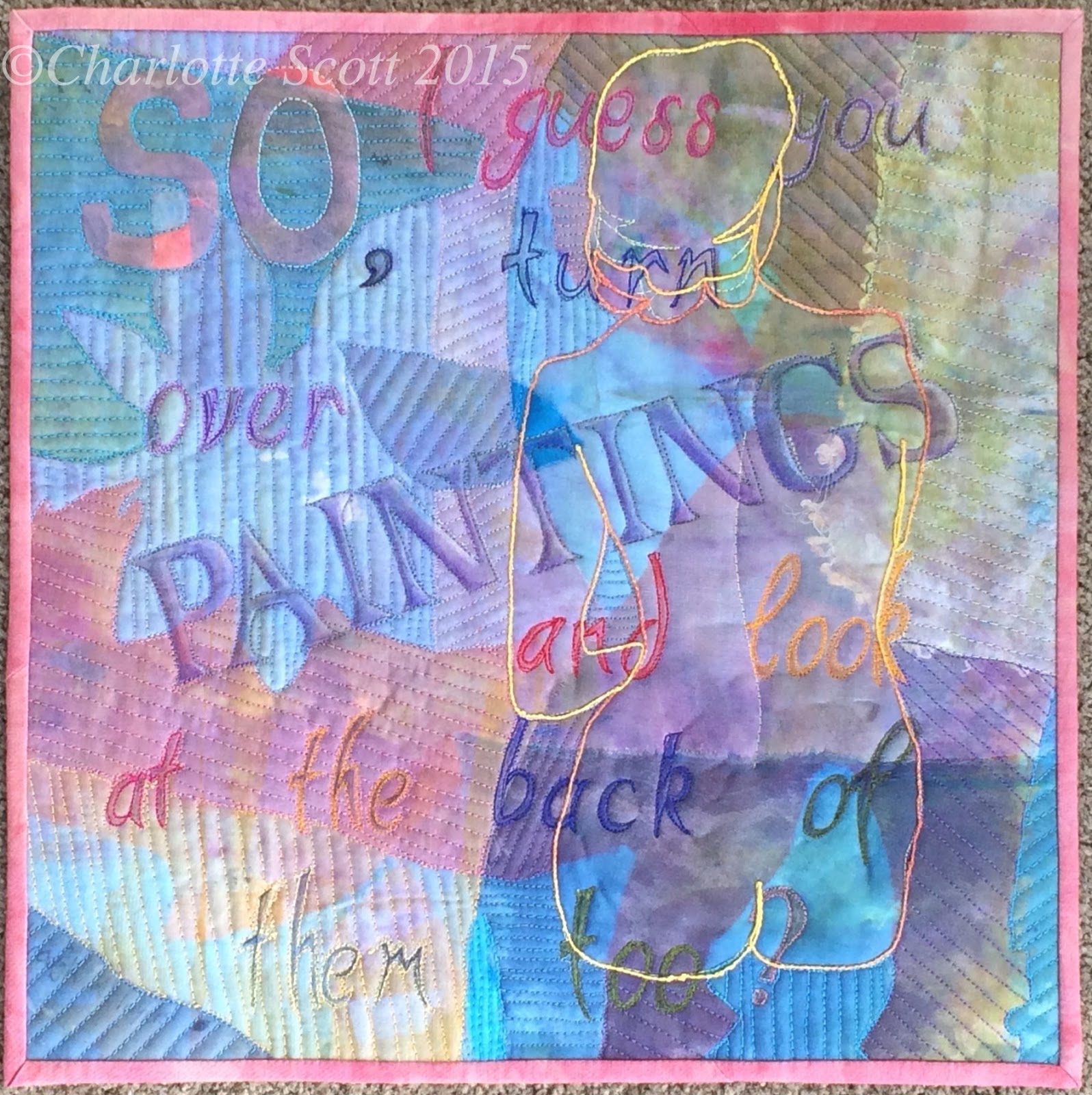
My quilt for this year is a little different for me, it's the first time I've really tried to include a message.

There is an ongoing debate about the back sides of art quilts.  Artists who exhibit art quilts at quilt shows often feel that the back of the quilt isn't relevant and shouldn't be judged.  Other's feel that in view of the traditions that art quilts spring from, the back is an integral part and should be celebrated as another aspect to use to convey a message.  And still other comments I've heard are that painters never consider the back of their work, so why should we?

It goes round and round and round!

I'm not sure where I stand on the debate.  And hence my quilt: Seeing Both Sides of the Story.


The text on the front reads,"So, I guess you turn over paintings and look at the back of them too?"  Which is something I've heard as a reply to people saying the backs of art quilts are important.  You can say it with a sarcastic tone or not, up to you!

I began with white fabric and a fabric pen.


Then I used layers of hand painted and dyed silk organza.  I wanted a painterly feel with depth and translucency.


I worked up the text by quilting around the letters and using coloured pencil and colourless fabric paint to highlight them.


The outline of a woman's back was done using a heavy thread in the bobbin and free-motion quilting.  I used this motif for a couple of reasons - obviously the 'back' of the woman ties in with the statement of the 'back' of quilts.  I also wanted people to think about both sides of things, how one side can be hidden but perhaps be the more revealing.  I also wanted to reference fine art - nudes often appear in the traditional masters you see in museums.


The back of the quilt has a hand written mini essay.  It is hard to read in the photograph, but easier in real life.  This is what it says:

Textile is tactile; it begs to be touched and fondled, to engage that kinaesthetic sense. Yes, we hang textile art of the walls, but we also wrap ourselves in it. Should not the back be another aspect to engage with, to admire? Why do we insist on trying to make art like painters? We aren't painters, we are quilters, and we stitch though all three layers. So, let us celebrate a marvellous attribute of our medium and embrace THE BACK.


And this, for me, is the other side to the back side story.  I wanted this on the back so you would have to turn over the quilt (the action that the whole debate is about) to read it.

I bound the edge with a very skinny single fold binding, popped in an envelope, crossed my fingers and sent it winging towards the USA.  It arrived safe and sound and now appears on SAQA's auction pages, page 8.


There are many, many beautiful quilts up for auction.  There are also many videos of how individual artists created their art.  Go and have a look - you will inspired and amazed at the beautiful work.   And please share the link with others so that they can see the quilts too.

PS - I'd love to hear your thoughts about the back of art quilts, please leave me a comment.

Saturday, June 6, 2015

Podcast - Being a Quilter's Kid

I thought I'd talk with my children to get an insight on what they thought about quilts, quilting and having a quilting obsessed Mum.  They were happy to oblige and there are interesting, funny and a few golden moments through our interview.

They both talk about their bed quilts I've made them.


You know the saying about tailor's children having no shoes?  Well, my kids have quilts, but they are both years old, very well loved and consequently getting tatty.  These old photos show me that at least my photo taking ability has improved, but it's also long overdue for me to make new quilts for them I think.  You'll hear Liv request a fairy princess with a pretty dress riding a unicorn pegasus.......sure, I'll knock that off by next weekend!

And here's a picture of the quilt we were sitting on.  I asked them how much they thought I should sell it for....I'm hoping you'll gasp in horror when you hear the figure they suggested!


I hope you enjoy listening.  Apologies if the sound fades in and out a little, I was chasing two kids and a cat round my bed....


Download this episode (right click and save)

Saturday, May 30, 2015

Organic, Modern, Graphic Quilts! OMG quilts, a new idea?


Helen Godden is an Australian quilt artist (find my podcast interview with her here), who has been working with a couple of colleagues - Suzanne Hyland and Michelle Pearson - on a new idea.  She calls it OMG!  This stands for organic, modern, graphic quilts - a variation within the modern quilting movement.  There is a OMG Facebook group that was started in April and it's been growing with exponential speed.  Currently there are 895 members.

I'll let Helen tell you more about the birth of the idea:
"Teaching at Handi Quilter academy Utah 2014, Suzanne and I were discussing the sweeping popularity of the Modern Quilting style. For me I love the space and importance given to lots of free-motion quilting but ...anyone who knows me knows...I don't piece! Piecing seems to be fairly integral to Modern quilting.
As always my mouth engages before my brain has slipped into gear and I thought out loud and said "Why does Modern have to be pieced? Why can't it be more organic?" I jumped up, grabbed a marker and wrote OMG in  large letters on the white board and announced 'Organic Modern Graphic quilts.'"
Helen presented the idea at the Canberra Modern Quilt Group in April and it was suggested she start a Facebook group.

The idea behind the Facebook group is to encourage members to make OMG quilts, Helen calls it,"a non-profit quilting stimulator".  There are quite strict guidelines as to what constitutes an OMG piece (appliqué, non-pictorial, size restrictions, quilting integral to the design etc) but, if it fits within the criteria, it is accepted as an OMG quilt and awarded an OMG order of creation number.


Helen's OMG quilt called OMG #4 UBER, just won first place in the Negative Space category of the Kiama Modern Quilt Show.  OMG quilts #1, #2 and #3 were also all created by Helen, although #3 is now known as 'Onion formerly known as OMG #3', which reflects a guideline change that occurred later on.  OMG #5 was created by founder Michelle Pearson, but from #6 onwards there is a whole variety of creators.


This is Coral's OMG quilt, called OMG #14 I'll be Clammed!  Coral, a quilter living in Australia (find her at @coralquilts on Twitter and Instagram) talks about making it: "I was having a pretty stressful week, so busting out an OMG was a great stress reliever.  I always wanted to make a clamshell quilt, but paper piecing was a lot of work, so I decided to use the raw edge appliqué technique to do it on my OMG instead."

Normally, really strict rules turn me off.  But, as Twyla Tharp talks about in her book "The Creative Habit" sometimes restrictions can really spark the creative juices.  And, judging by the popularity of the group and the number of OMG quilts being made (33 at last count, and this doesn't include the OMG children, which are quilts made from the offcuts and leftovers of the parent OMG), it appeals to other quilters too.

Coral states,"I think the appeal is the freedom of the raw edge appliqué.  Any shape you want to make.  Also you can make them pretty quickly, while still doing some fun and exciting FMQ."

I think another aspect that appeals to me is that this seems to be something new.  A new concept, which is pretty hard to find in this world today.  And I don't mean making appliqué, abstract quilts is new, but the whole OMG group etc is new, just like the modern quilting movement was new and appealing when it first appeared as a concept.

Perhaps it is also the sense of community that in attractive?  I think there is a bit of breakdown in some of the traditional forms of clubs and guilds, and Facebook, Instagram and Twitter groups are replacing that sense of belonging we get from hanging out with people who 'get' what we do.  And how could I forget to mention blogs!  I don't know where I'd be without my blog followers!

So I watched for a little while to get the concept and then I jumped in and decided to make one.  I'm working with the second to largest size allowed, 30 x 40 inches.  My design started with free cut circles but I wanted to make the background an integral part of the design instead of plain fabric (I hate BB's - boring backgrounds), so I cut background pieces out of several different neutral fabrics and one orange/brown linen napkin that just jumped up and demanded in.  These backgrounds were glue basted to the back of the circles and excess cut away to reduce bulk.


Now I'm busy quilting, and I tell you - this much concentrated free motion quilting is really improving my skills!  Once it's done, I'll have to submit it for consideration by HHH (hard hat Helen) and see if it is approved for an OMG number.  It's an interesting process - kinda like seeing if your quilt is juried into a show.  Helen often provides a critique, which I think expands the thought processes about what an OMG quilt is, and what area that particular OMG quilt either excelled in or perhaps needed more work in.


So what do you think about the concept of OMG?  Am I right in thinking that it's something new?  Are you part of OMG, and if you are, what appeals to you about it?  The Facebook group is called OMG quilts - go take a look and let me know your thoughts.