My name is Charlotte, sometimes known as Ms Lottie, occasionally as The Slightly Mad Quilt Lady. This is my blog, where you'll find me writing a lot about my quilting and textile arts and a little about my family's life in a small seaside town in New Zealand. Haere mai!
Showing posts with label handdyed. Show all posts

Sunday, September 8, 2019

Mud vs. Rainbow - thread dyeing

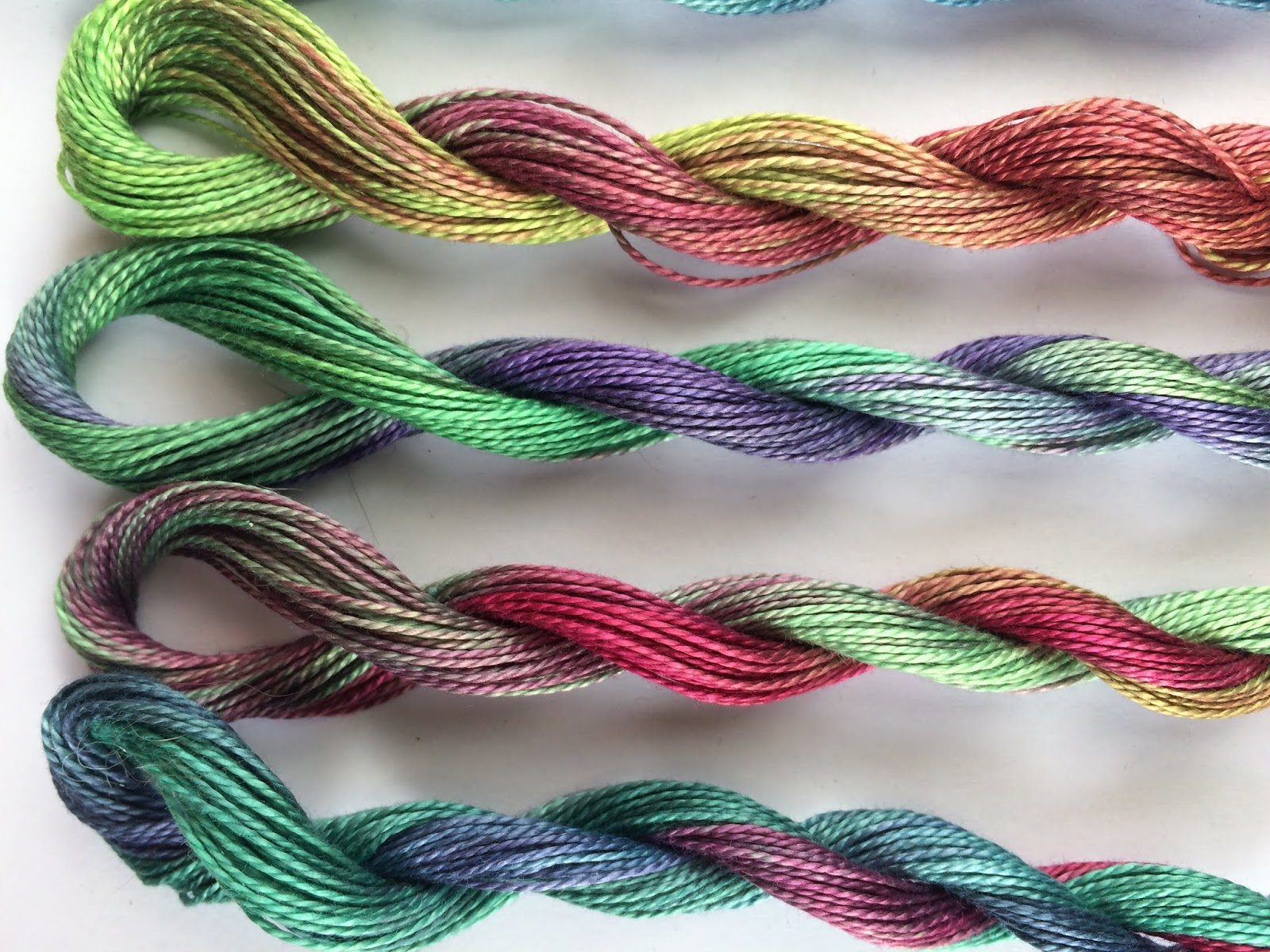
I promised I’d let you know whether I got mud or pretty colours with my thread dyeing experiment yesterday.


Well, they’ve been soaked (several times), rinsed, washed, dried and wound into skeins, and voila....!


I was honestly surprised that they turned out as well as they did. There are a couple of places where they are a little ‘blotchy’. And on a couple the colour change from one to the next is sharper than I’d like, but then again, that might appeal to some people.

In the photo below you can see in the top skein and the third one down are a little patchy near the ends. But they are still lovely colours.


I’ve spent today back in the studio dyeing up another 25 skeins and another bunch of fat quarters and half metres. Now my feet hurt, and all the washing and rinsing is yet to come!

Oh, and here’s the white fat quarter the threads were sitting on. It’s not bad!


My dye table where all my dye bottles sit. I'm considering putting a piece of fabric down on the table next time, then I might get all that gorgeous patterning somewhere I can use it instead of just wiping it off.

Friday, February 24, 2017

Results of using old fibre reactive dyes with vinegar on silk fabric

I recently posted about testing some old fibre reactive dyes on cotton fabric.  The results were dismal, but instead of throwing the dye out, I decided to test something I had read somewhere about using old fibre reactive dyes with vinegar (turning them into acid dyes) and using them on silk.

Before and after rinsing photographs when the dye was used on cotton.
I have never used acid dyes on silk before so I had to look around for information on how to go about it.  The companies that sell dyes have pretty good information on their websites and if you google your question you'll come up with lots of opinions.

The general consensus seemed to be that acid dyes need heat to work.  So I soaked my silk scarf in vinegar (apple cider just because it was what I had around, but I'd probably recommend just using white vinegar!) I squeezed it out and poured on the dye solution, which I'd previously made up to my normal strength recipe with water.

Then I put the whole container in the microwave, loosely covered to avoid splashes and buzzed it on high for three minutes until it was boiling, let it rest for a few minutes and then buzzed it again for another two minutes.  I let it sit for a couple of hours and then began to rinse it.

And rinse it.

     and rinse it

        and rinse it.....

This photograph is after several days of rinsing, soaking overnight and rinsing again.  The water was still not clear after the last night of soaking but it was a lot better than it had been (and I'd lost patience by then).  The colour is deep and vibrant.


So, in conclusion:
  • old, exhausted, fibre reactive dyes that no longer work on cotton fabric will work as acid dyes on silk fabric, but,
  • the resulting colour does not appear to be as colourfast as fibre reactive dyes used with soda ash on silk (I use that combination on silk frequently with great results).
Now, I have only conducted one experiment on this so I'm no great expert.  I think I need to conduct some further trials with some of the other old dyes that I've been given, particularly trialling different colours as they can behave quite differently.

For further resources on dyeing fabrics, try:

Dharma Trading http://www.dharmatrading.com/home/information-you-can-use-from-dharma-trading-co.html

Paula Burch http://www.pburch.net/dyeing.shtml

And, as Brenda suggested in the comments on my last dyeing post, Carol Soderlund is a bit of a dyeing legend and has great resources on her blog http://www.carolsoderlund.com

Sunday, February 12, 2017

Why it pays to test your dyes.

I received some old procion fabric dyes from a textile artist who longer needed them.  Unsure of their age or how they've been stored, I'm using them hesitantly and if it's for something important, I'm testing them first.

Here is a really good example why.


I made this blue dye up as per my usual recipe and added it to soda ash soaked cotton fabric as per
normal.

The top photo is the dye solution squeezed through the fabric.  I left it to batch for over 24 hours and then took the bottom photo after it was rinsed.  You always get some washout and lightening but the amount that I got is nowhere near acceptable and shows me that this particular dye has well and truly lost its potency.

I searched for Multicraft Manufacturing Ltd online and I found that it was dissolved as a company in 2009, so that gives me a hint as to just how old that dye might be!

The reason I was testing this particular dye was because I had been mucking about doing random serendipitous work with the gifted dyes and noticed that none of my pieces had turned out as blue as I expected after the rinse.  However, I also had a few pieces of silk organza in the mix and they are quite blue.  I've read somewhere that you can use old procion dyes on silk with vinegar (protein fibres work best with acid as a fixative whereas cellulose fibres need a base) and get good results.  So before I biff this jar of dye powder I'm going to run one more test on silk with vinegar.

Watch this space.

Sunday, April 10, 2016

More Herons, and a tease of Ungainly Grace

There is another heron quilt I didn't include in the last blog post.  It was one created for the SewEzi Aotearoa Quilters Flight Challenge, which is being exhibited as part of the Great NZ Quilt Show, the first weekend of May, in Rotorua.

I got very good news yesterday that my quilt, titled Ungainly Grace (recognise the reference to the quote in the last blog post?), was chosen as one of the twenty finalists!  Yay!

Here is the drawing I started with:


It is a sketch from one of my own photographs of a white faced heron:


Unfortunately I can't show you the full quilt yet, but I can tell you it is 75cm square, as they all will be, and I can tell you that working in a square format is difficult for me! 

 I was discussing it with my mentor (Lisa Call, in case you are looking for a wonderful teacher/life coach) and she suggested that a landscape or portrait format has instant expressiveness without even adding the art.  Think horizontal = calm, portrait = power.  But a square makes you work harder to convey the feeling you want.  You can only work with the images and layout within the square, you can't rely on the shape of the frame.  Interesting.

I can also tell you that there was hand-dyed silk and much free motion quilting on my Bernina 440 domestic machine.  


There was also much thread tying in.  Ho hum.


And there may have been a last minute dash to sew on the label in my car on the way to drop off the quilt (not while driving - just waiting for carpooling!).


But I was very happy with the final result.  It is subtle and my aim was to work with tones and get them right rather than relying on colour to do all the work.  I think I got there, but you'll have to wait till the show to see if you agree with me.


For now, this is just a glimpse.

See you at the show!

Here is a link to a great blog post written about the upcoming show - I'm biased 'cause I wrote it! 

Thursday, September 3, 2015

The green in the GREEN

I promised you I'd show you how I was going to rectify the little problem I had of white and cream quilts for a green colour challenge.


I stitched around the edges of each piece, made up three slightly different dye baths, soaked the pieces in soda ash and then in they went.

And now they are GREEN! 


The silk moth didn't take as much of the black (the dye bath was mostly yellow and black) and is quite yellow.  Interesting, especially as you do get an occasional yellow Puriri Moth as a variation of the species.


This one needed a little tuck in it along the trunk as all the different fabrics shrunk a little bit differently, but that's ok and the beauty of improv.  This moth I expected to be much lighter as the shirt it was made from (my husband's wedding shirt!) was 30% polyester and shouldn't have taken up the dye as well as it did.  The Puriri Moth is also known as the Ghost Moth....


And the furry texture of the moth made of batting delights me!  I've since added another 'ghost' moth to this was some discharge paste.

Now it's time for quilting.  I think a wood grain would suit, seeing as they eat trees.